Uranus Moons: NASA's Deep Dive Beyond Any Rosy Glow
When we cast our gaze upon the distant celestial bodies of our solar system, imagination often paints vibrant tapestries. Perhaps you've envisioned a tranquil "uranus rosy glow" emanating from its icy surface or reflected off its mysterious moons. While such poetic imagery is alluring, NASA's deep dive into the Uranian system reveals a reality far more profound, complex, and scientifically captivating – though notably devoid of any actual "rosy glow." Instead, we find a frigid, ancient world and its retinue of diverse moons, each holding clues to the solar system's tumultuous past and the incredible forces shaping its evolution.
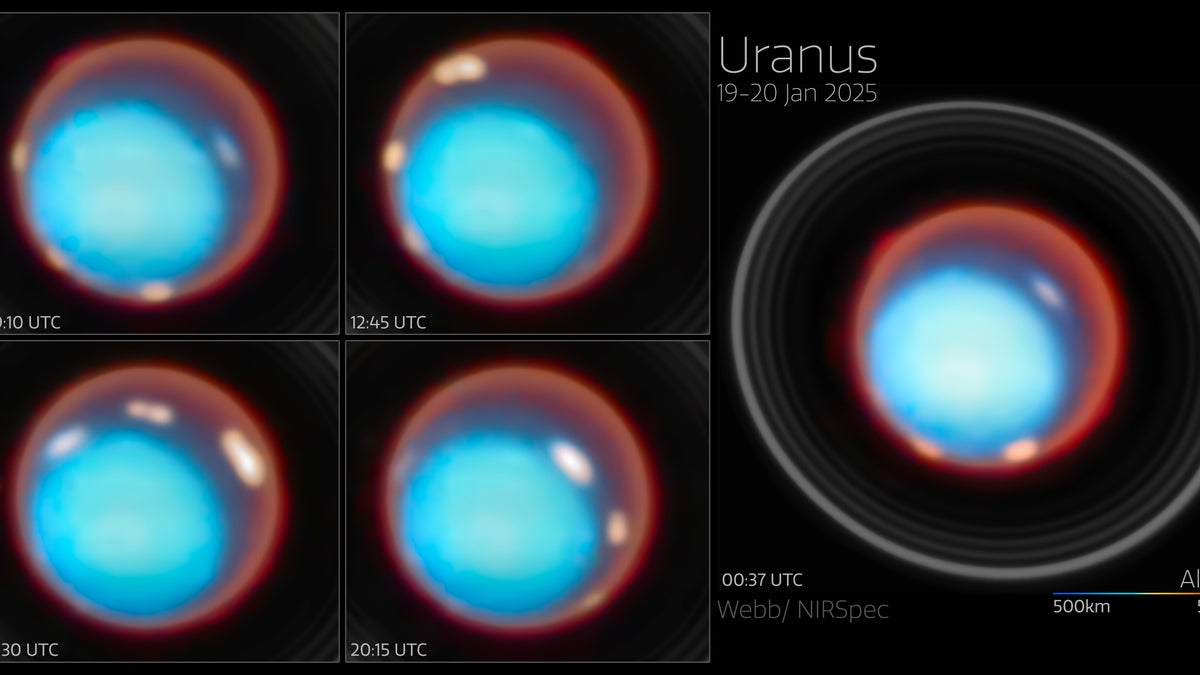
The very notion of a "uranus rosy glow" quickly gives way to the planet's true, breathtaking cyan hue, a result of methane in its atmosphere absorbing red light. This subtle, ethereal blue-green is what defines Uranus, a giant unique for its extreme axial tilt and frigid temperatures. Understanding this reality is key to appreciating the incredible scientific journey NASA has undertaken to explore this distant ice giant and its numerous satellites.
The Enigmatic Uranian System: A Tilted Giant's Realm
Uranus, the seventh planet from the Sun, stands out in our solar system as a true anomaly. Unlike other planets that spin more or less upright, Uranus lies virtually on its side, with its axis tilted a staggering 98 degrees relative to its orbital plane. This dramatic tilt leads to extreme seasons, where one pole can face the Sun for decades, plunging the other into equally long periods of darkness. This unique orientation undoubtedly influences the dynamics of its moon system, creating an environment unlike anything else we've observed.
The planet itself is an ice giant, composed primarily of various ices (water, ammonia, methane) atop a rocky core, shrouded by an atmosphere of hydrogen, helium, and methane. Its distance from the Sun means it receives significantly less solar radiation than Earth, leading to incredibly low temperatures, often dropping below -224 degrees Celsius (-371 degrees Fahrenheit). This extreme cold, combined with its unique atmospheric composition, confirms that any imagined "uranus rosy glow" is purely a figment of romantic speculation, superseded by the stunning scientific facts of its icy blue reality. For more foundational insights into the planet itself, delve into
Exploring Uranus: NASA's Solar System Facts, No Rosy Glow Data.
Uranus's Moons: Diverse Worlds Beyond Imagination
Uranus boasts 27 known moons, a collection far more diverse and geologically active than one might initially expect from such a frigid, distant system. They range from the diminutive, irregularly shaped inner moons, believed to be "shepherd moons" interacting with the planet's faint ring system, to five large, spherical satellites that tell stories of ancient geological turmoil.
These five major moons – Miranda, Ariel, Umbriel, Titania, and Oberon – were all discovered between 1787 and 1948, primarily by William Herschel and Gerard Kuiper. Each possesses a distinct personality, challenging our preconceived notions of static, ice-bound worlds.
*
Miranda: The Mismatched Puzzle Piece
Miranda is perhaps the most captivating of Uranus's moons, known for its bizarre, patchwork appearance. Its surface is a jumble of ancient, heavily cratered terrain interspersed with dramatic, younger features called "coronae" – vast, roughly rectangular or trapezoidal regions bounded by faults and ridges. Scientists theorize this unique geology could be the result of either intense tidal heating in its past, leading to resurfacing, or perhaps even a catastrophic impact that shattered and reassembled the moon. The lack of a "uranus rosy glow" here is replaced by the stark beauty of its chaotic geology, a true testament to the violent forces in the early solar system.
*
Ariel: The Bright and Tectonically Active
Ariel stands out as the brightest and, surprisingly, the second most tectonically active of Uranus's moons. Its surface is marked by extensive fault systems, canyons, and valleys, suggesting geological activity that has reshaped its landscape. Evidence of flowing ice – perhaps a form of cryovolcanism – further suggests a dynamic past, possibly driven by tidal heating from Uranus. Its brightness hints at a relatively young surface, implying ongoing processes.
*
Umbriel: The Dark and Mysterious
In stark contrast to Ariel, Umbriel is the darkest of the five major moons, exhibiting a heavily cratered, ancient surface that shows little evidence of geological activity. Its uniformly dark complexion suggests a composition rich in carbonaceous material or complex organic compounds, potentially primordial materials untouched since its formation. The only notable bright feature is a puzzling ring of material near its equator, the origin of which remains unknown.
*
Titania: The Largest and Canyon-Riddled
Titania is Uranus's largest moon, characterized by a complex network of enormous fault systems and scarps that slice across its surface, some extending for thousands of kilometers. These grand canyons suggest significant extensional tectonics, likely driven by internal processes or perhaps expansion due to a subsurface ocean freezing. Its surface is moderately cratered, hinting at both ancient and relatively recent geological activity.
*
Oberon: The Outermost and Most Ancient
Oberon, the second largest and outermost of the major moons, presents a heavily cratered, ancient surface, similar to Umbriel but with some intriguing exceptions. It features a prominent mountain or peak, standing perhaps 6 kilometers high, suggesting internal forces have been at play, even on this seemingly dormant body. Its dark material in the floors of craters points to some resurfacing or infilling event.
These moons, observed primarily by Voyager 2 during its fleeting 1986 flyby, offer tantalizing glimpses into worlds shaped by ice, rock, and gravitational forces. Far from the simplicity of a "uranus rosy glow," their intricate details reveal the solar system's true complexity.
NASA's Continued Quest: Why Uranus Matters
Despite the limited data from a single flyby, NASA and the broader scientific community view Uranus and its moons as critical targets for future exploration. The ice giants, Uranus and Neptune, represent a distinct class of planets different from the rocky inner worlds and the gas giants (Jupiter and Saturn). Studying their formation, evolution, and moon systems can provide invaluable insights into:
*
Planetary Formation: Understanding how these ice giants formed in the outer solar system sheds light on general planet formation processes, including those in exoplanetary systems.
*
Internal Structure and Dynamics: The unique magnetic fields and atmospheric compositions of ice giants present puzzles that require more detailed investigation.
*
Moon Evolution: The geological diversity of Uranus's moons, particularly their evidence of past activity, raises questions about the sources of internal heat far from the Sun. Tidal forces, radioactive decay, or even impacts could play roles.
*
The Origin of Life: While unlikely to host life as we know it, the presence of water ice and complex organic molecules on some moons contributes to our understanding of the building blocks of life in extreme environments.
Sending an orbiter to the Uranian system would revolutionize our understanding, providing high-resolution images, compositional analysis, and long-term observations that a flyby simply cannot. Such a mission would undoubtedly unveil more intricate details, far surpassing any imagined "uranus rosy glow" with the sheer brilliance of scientific discovery. To further unravel the complexities of this distant ice giant and its entire cosmic neighborhood, consider
Unveiling Uranus: NASA's Insights on its System, Not Rosy Glow.
Practical Insights: Observing and Understanding Distant Worlds
While direct observation of Uranus's moons through backyard telescopes is challenging due to their small size and the planet's vast distance, aspiring astronomers can still engage with these distant worlds:
*
Utilize Online Resources: NASA's Solar System Exploration website, along with images from the Hubble Space Telescope and ground-based observatories, offers a wealth of stunning visuals and scientific data.
*
Study Analogous Systems: By comparing the features of Uranus's moons to those of Saturn (e.g., Enceladus, Dione) or Jupiter (e.g., Europa, Ganymede), scientists can infer potential geological processes and compositions.
*
Support Space Exploration: Advocacy for future missions to ice giants is crucial. These missions represent humanity's frontier spirit and our relentless pursuit of knowledge.
The absence of a "uranus rosy glow" in scientific data doesn't diminish the wonder of this distant world. Instead, it highlights the importance of relying on empirical evidence to truly appreciate the universe. The cyan beauty of Uranus and the surprising geological activity of its moons offer a profound reminder that reality often surpasses even the most vibrant human imagination.
Conclusion
The concept of a "uranus rosy glow" might appeal to our aesthetic sensibilities, but the reality offered by NASA's deep scientific exploration is infinitely more fascinating. From the planet's dramatic axial tilt to the surprising geological diversity of its major moons – Miranda's chaotic terrain, Ariel's fault systems, Umbriel's ancient darkness, Titania's vast canyons, and Oberon's immense craters – the Uranian system is a testament to the dynamic and often violent processes that shaped our solar system. Far from a mere rosy glow, what we find is a complex, icy realm begging for further investigation, holding secrets that promise to redefine our understanding of planetary evolution and the very nature of worlds beyond Earth. Our continued quest to explore these distant frontiers is a testament to humanity's enduring curiosity and our insatiable desire to unravel the cosmos's most profound mysteries.